
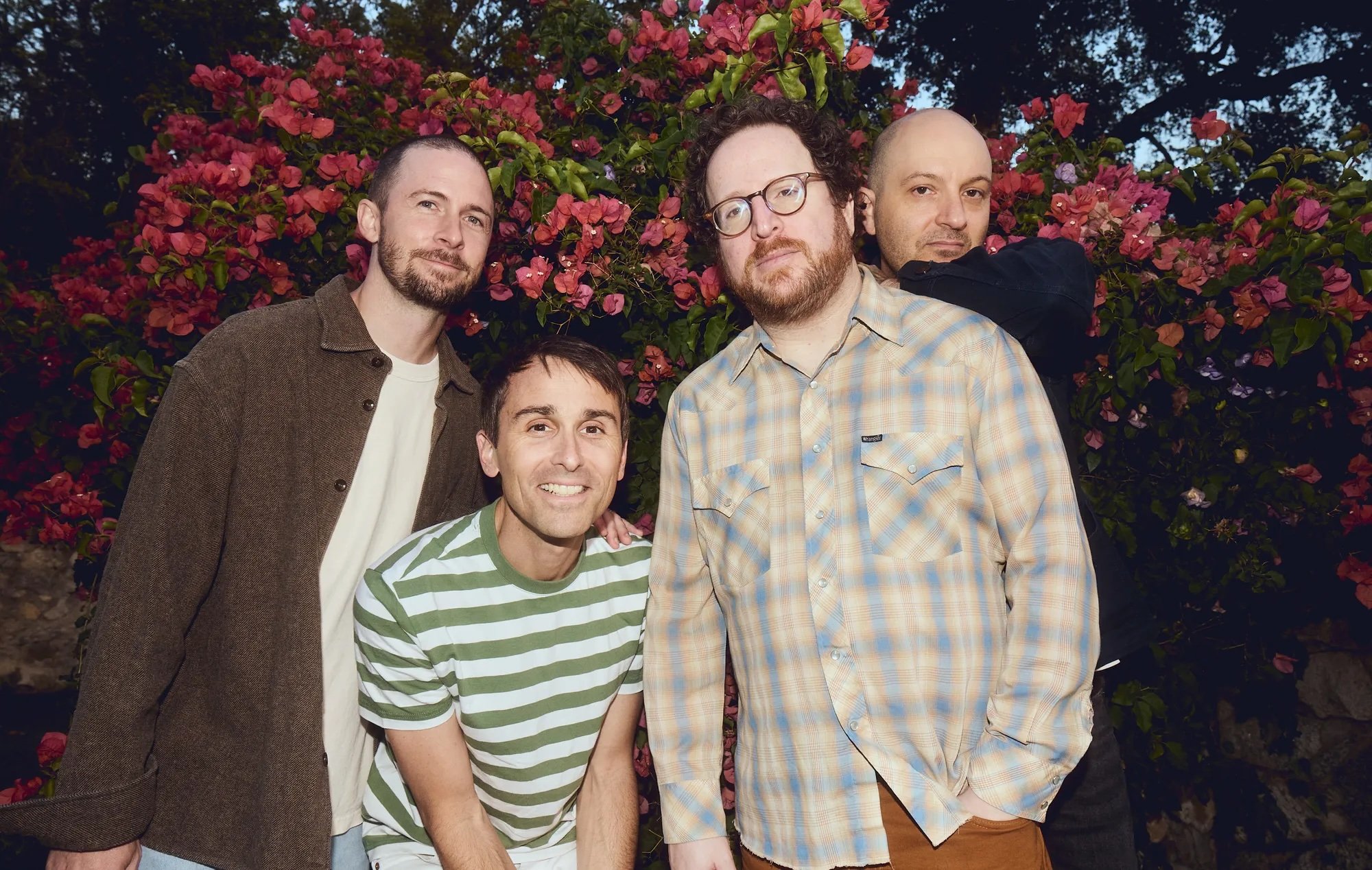
Photo Credit: Sami Drasin
THE PRETTY FLOWERS
In 2024, The Pretty Flowers’ vocalist/guitarist Noah Green left the cramped apartment in Koreatown where he had lived and written music for 13 years. He and his wife Natalie and their two cats relocated to a house in the foothills of Sierra Madre, a sleepy town 15 miles east of Los Angeles. The sirens and midnight screams of Western Avenue gave way to the wild silence of the San Gabriel Mountains. In this setting he wrote the second half of the album that became Never Felt Bitter. “I think it had a lot to do with space,” says Green of the new work. “I’d just never had space like that before.”
That sense of expansion illuminates Never Felt Bitter, the band’s third full-length album and their first for the Chicago-based Forge Again Records. The power pop of their previous works is reinforced by a newfound physicality. From the gigantic hooks of “Ocean Swimming” to the ferocious urgency of “To Be So Cool.” From the relentless industrial current of “Ring True” to the buzzsaw intensity of “Never Felt Bitter (We Burn).” This is the band-as-total-unit, each song announcing its arrival with its own unique detonation of pure pleasure.
Recording sessions were completed at Adam Lasus’s Studio Red in North Hollywood and began in a borrowed house in the hills above Laguna Beach. The band set up their gear in a circular living room overlooking the Pacific Ocean. The songs live up to the vastness of that view. Witness the slow build of “Thief of Time” break into a tidal-wave chorus.
Themes of anxiety, regret and resolve surface via fragmented memories. Melodies are spiked with specific images that linger long after the final chord rings out. The cows falling through the fault line in “Ocean Swimming”; John Wayne hiding in the bushes above the 110 freeway in “Convent Walls”; The Mötley Crüe mirror in “Tough Love.”
Though The Pretty Flowers avoid emulation, the songs are laced with echoes of their ancestors, whether it’s The Replacements in “Big Dummy,” or Teenage Fanclub in “Convent Walls.” It’s possible to hear Elliott Smith’s whispering influence in the mists of “Not Dissolve,” its eerie premonitions of becoming “fair princes of the cut-out bin” building into the ominous psychedelic storm that closes the album.
Four musicians with day jobs. Infinite hours sunk into the dubious Sisyphean glory of stewarding a rock band. Yet music may just be the last best defense against a world going off the rails—or at least that’s how it feels when “Came Back Kicking” shifts into high gear:
We went walking under black skies
We wore out the terrain
It may have taken billions of years
But it had to happen sometime
This was the first song Noah wrote after moving to the mountains. He was listening to Echo & the Bunnymen and The Waterboys and pondering his own personal concept of “big music.” “Certain songs just make you feel connected to something larger,” he says. “Songs that in some other decade or dimension could have been hits on the radio.”
The album's cover image comes from Bonnie Donahue and Warner Wada’s landmark photo essay Control Zone, which follows a family living in Belfast during The Troubles. Green discovered the book while browsing Brattle Book Shop in Boston. “It captures this one family’s struggle and resilience against oppression,” says Green. “Something about the image seemed to fit the feeling of our new music.”
In April 2025, in the midst of finishing the sessions for Never Felt Bitter, the band debuted “Thief of Time” on the steps of L.A. City Hall—the opening salvo in a series of 50501 protests against rising American authoritarianism. In front of some 50,000 spectators, a song of doubt morphed into an anthem of faith, rage and release. Listening now to its tectonic chorus, it’s hard not to feel you’re hearing a band that has finally found its moment.